A good certificate program example has four parts: a defined audience, a structured learning path, an assessment with a clear pass mark, and a certificate with a renewal rule. Below are six illustrative models, from employee compliance to a coaching academy, that you can adapt when you are creating a certification program of your own. They are examples to learn from, not real organizations, so adjust every detail to your own context.
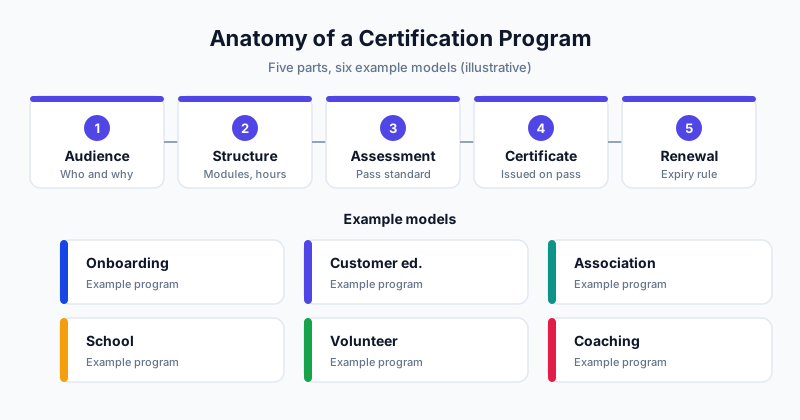
The Anatomy of Any Certification Program
Before the examples, it helps to see the pattern they all share. If you are starting from zero, our guide on how to create a certificate program walks through each stage in more detail.
- Audience and outcome: who the program is for and what they will be able to do afterwards.
- Structure: modules, hours, format (live, self-paced or blended).
- Assessment: a quiz, project, observation or attendance rule, with a stated pass standard.
- Certificate: the document issued on success, with name, program, date and a way to verify it.
- Renewal: whether the credential expires and how it is refreshed.
Example 1: Employee Onboarding and Compliance Program
Who it is for: every new hire, plus existing staff once a year.
Structure: four short modules covering workplace safety, data protection, code of conduct and tools access. Self-paced, about two hours in total.
Assessment: a short quiz after each module and a final quiz with a pass mark such as 80 percent. Unlimited retakes, with the score recorded.
Certificate type: a certificate of completion naming the program and the completion date. See the corporate training certificate guide for wording.
Renewal: annual. The certificate carries an issue date, and the program owner reruns the cohort each year.
Example 2: Customer Education and Product Training Program
Who it is for: customers, partners or resellers who use a product and want to prove they use it well.
Structure: three levels, for example Foundations, Practitioner and Advanced, each unlocking the next.
Assessment: a knowledge check at the end of each level, plus a practical task for the top level such as configuring a sample workflow.
Certificate type: a level-specific certificate, so someone can display "Practitioner" separately from "Advanced".
Renewal: tied to product updates. When a major release changes the workflow, a short refresher keeps the credential current.
Example 3: Professional Association Credential
Who it is for: members of a trade or professional body who want a recognised standard of knowledge.
Structure: a defined body of knowledge, a recommended study path and a scheduled exam.
Assessment: a proctored or timed exam, sometimes combined with documented experience.
Certificate type: a formal credential certificate with a unique ID and a public verification page so employers can confirm it.
Renewal: every few years through continuing education. Our CEU certificate templates guide covers how those credits are recorded.
Example 4: School Enrichment Program
Who it is for: students taking an after-school or holiday track, such as coding, public speaking or robotics.
Structure: weekly sessions over a term, ending in a showcase.
Assessment: attendance, a short project and teacher feedback. The pass rule is usually participation plus project completion rather than an exam.
Certificate type: a certificate of achievement or completion, often with a line about the project. Our education and academic certificates page shows suitable layouts, and the school certificate guide covers wording.
Renewal: none. A new term brings a new certificate.
Example 5: Community and NGO Volunteer Program
Who it is for: volunteers who give time to a nonprofit, food bank or local campaign.
Structure: an orientation session, role-specific training and a minimum number of service hours.
Assessment: hours logged and a supervisor sign-off. No exam is needed.
Certificate type: a certificate of service or appreciation that records hours and role. Our community service certificates page and the volunteer certificate guide show how.
Renewal: optional. Many programs reissue annually to reflect cumulative hours.
Example 6: Coaching Academy Certification
Who it is for: people training to become coaches, facilitators or trainers through a private academy.
Structure: a cohort-based course with live sessions, reading and supervised practice hours.
Assessment: a case study, a recorded practice session reviewed against a rubric, and a final reflection.
Certificate type: a graduate certificate stating the program, hours of training and the date. See the coaching program certificates page for templates.
Renewal: typically none for the academy's own certificate, though the academy may invite graduates to annual refresher workshops.
Side-by-Side Comparison
| Program | Assessment | Certificate | Renewal |
|---|---|---|---|
| Onboarding and compliance | Quizzes, 80% pass mark | Completion | Annual |
| Customer education | Knowledge check plus task | Level-based | On major updates |
| Professional association | Timed exam | Credential with ID | Every few years |
| School enrichment | Attendance and project | Achievement | None |
| Volunteer program | Hours and sign-off | Service | Optional |
| Coaching academy | Case study and rubric | Graduate | None |
How to Choose Your Own Model
Start with what a certificate must prove. If it proves exposure to information, use completion and attendance rules. If it proves skill, use a graded assessment. If it proves ongoing competence, add an expiry and a renewal path. The more a third party will rely on the certificate, the more important a clear standard and a verification method become. For internal staff versions, see our guide to an internal certification program for employees.
Getting Started
Whichever model you choose, the delivery step is the same: collect the people who passed, fill in a template and send each certificate with a way to verify it. SendCertificates lets you upload a spreadsheet of passed participants, personalise each certificate with their name, program and date, email them in bulk and track delivery. You can start free with 50 credits and run a pilot cohort first.
Related Guides
Tags