An internal certification program is one of the most effective ways to raise skill levels, standardize how work gets done, and give employees a clear path to grow - all without sending people to expensive external courses. Done well, it turns your training from a one-off event into a measurable credential that employees actually value.
This guide walks through how to build one from scratch, step by step, and how to issue the certificates at scale once people start passing.
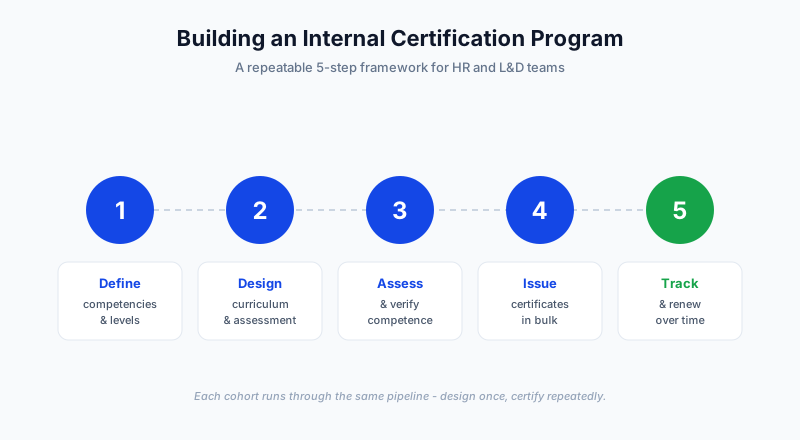
Why Build an Internal Certification Program
Most companies already run training. The problem is that training without certification leaves no proof that anyone actually learned anything. An internal certification program fixes that by adding a verification step and a credential at the end.
The business case is straightforward:
- Consistency - everyone certified to a standard does the work the same way
- Role readiness - you can require a certification before someone takes on a task or moves up
- Compliance - certificates create an audit trail for regulated work
- Retention - employees stay longer when they can see a path to grow
- Recognition - a real certificate feels more meaningful than a completed checkbox
Internal Certification vs External or Public Programs
It is worth being clear about what you are building. An internal program certifies your own people for internal purposes. A public or sellable program certifies outside learners and usually needs more formal structure. If your goal is to launch a program you sell to the public, read our guide on how to create a certification program instead - this article is about the internal version.
| Aspect | Internal program | Public / sellable program |
|---|---|---|
| Audience | Your employees | External learners / customers |
| Accreditation | Usually not needed | Often expected |
| Assessment rigor | Practical, role-based | Standardized, defensible |
| Primary goal | Capability and consistency | Revenue and market recognition |
The 7 Steps to Build Your Program
- Define the competencies the certification will prove
- Set levels if you need more than pass or fail
- Design the curriculum that teaches those competencies
- Build the assessment that verifies them
- Decide issuance rules - who certifies, what the certificate says
- Issue certificates to everyone who passes
- Track and renew so certifications stay current
The rest of this guide expands on the steps that organizations usually get wrong.
Defining Competencies and Levels
A certification is only as credible as the competencies behind it. Start by writing down exactly what a certified person should be able to do - not what they should know. Skills, not topics.
For example, instead of "understands customer onboarding," write "can complete a full customer onboarding independently, including account setup, data migration, and the first success call."
If a single pass or fail is too blunt, add levels:
- Foundation - can perform the task with supervision
- Practitioner - can perform the task independently
- Expert - can train and review others
Levels let the same program serve new hires and senior staff, and they give employees a reason to come back and re-certify at a higher tier.
Designing Assessments That Hold Up
Assessment is where most internal programs fall apart. A multiple-choice quiz proves someone can recognize the right answer, not that they can do the job. Mix assessment types:
- Knowledge checks for the facts that must be memorized
- Practical tasks where the employee actually does the work
- Manager or peer sign-off for skills that show up over time
Write the passing criteria before anyone takes the assessment, and apply them the same way to everyone. If two assessors would score the same person differently, your criteria are too vague.
Issuing and Tracking Certificates at Scale
Once people start passing, you need a clean way to issue certificates. Doing it by hand - editing a template one name at a time and emailing each file - breaks down past about ten people.
The practical workflow:
- Export the list of employees who passed, with name and email
- Add the program name, level, date, and any other fields you want on the certificate
- Save it as a spreadsheet (Excel or CSV)
- Upload it to SendCertificates with your certificate template
- Every employee receives a personalized, QR-verifiable certificate by email in minutes
Because each certificate carries a unique QR verification link, a manager, auditor, or future employer can confirm it is genuine without calling HR. For more on running this at volume, see our guide on employee training certificates best practices.
Keeping Certifications Current (Renewals)
A certification that never expires slowly becomes meaningless as tools, policies, and processes change. Set a renewal cycle per program based on how fast the underlying skill moves:
- Safety and compliance - typically 1 to 2 years
- Tools and software - when major versions change
- Stable core skills - may never need renewal
Track expiry dates centrally so you can prompt employees before their certification lapses, rather than discovering it during an audit.
Common Mistakes to Avoid
- Certifying attendance, not competence - showing up is not the same as being able to do the work
- No clear owner - assign one person or team to own the program end to end
- Vague assessment criteria - if it is not written down, it is not a standard
- Manual issuance - it does not scale and it looks unprofessional
- No verification - a certificate nobody can verify is just a decorated PDF
- Never reviewing the program - revisit competencies at least once a year
Bringing It Together
An internal certification program does not need to be complicated to be valuable. Define what "certified" really means, assess it honestly, issue a real verifiable certificate, and keep it current. Start with one role or one skill, prove the model works, then expand.
When you are ready to issue the certificates, SendCertificates lets you turn a spreadsheet of everyone who passed into hundreds of personalized, QR-verified certificates delivered straight to their inboxes.
Related Guides
Tags