If you run accredited training, a CEU certificate is not just a nice-to-have - it is the document a professional uses to keep their license or credential current. That means the format matters. Miss a required field and the certificate may not be accepted by a licensing board. This guide covers exactly what a continuing education certificate must contain, gives you a field-by-field template and sample wording, and shows how to issue them at scale.
What Is a CEU Certificate
A CEU (Continuing Education Unit) certificate is proof that a professional completed an approved continuing education activity. CEUs are a standardized way to measure non-degree learning, widely used in healthcare, engineering, accounting, and many licensed professions.
The standard measure is simple: 10 contact hours of instruction equals 1 CEU. The certificate records how many CEUs the person earned, along with the details a licensing body needs to accept it.
CEUs sit alongside other professional development credits like CPD and PDUs. If you want the broader picture of how these differ, read our professional development certificate guide.
CEU Certificate Required Fields
A CEU certificate carries more required information than an ordinary completion certificate, because it has to satisfy an accrediting body. At minimum:
| Field | Why it matters |
|---|---|
| Recipient's full name | Must match professional records |
| Program / activity title | Identifies the approved activity |
| CEUs earned | The core credit value (e.g., 1.5 CEUs) |
| Contact hours | The hours behind the CEU calculation |
| Completion date | Fixes the credit to a renewal cycle |
| Issuing organization | The provider delivering the activity |
| Accreditation body | The authority recognizing the credit |
| Provider / approval code | Required by many accreditors |
| Authorized signatory | A real, named person |
| Certificate ID | For records and verification |
| Verification QR / link | Lets boards confirm authenticity |
CEU Certificate Template (field-by-field)
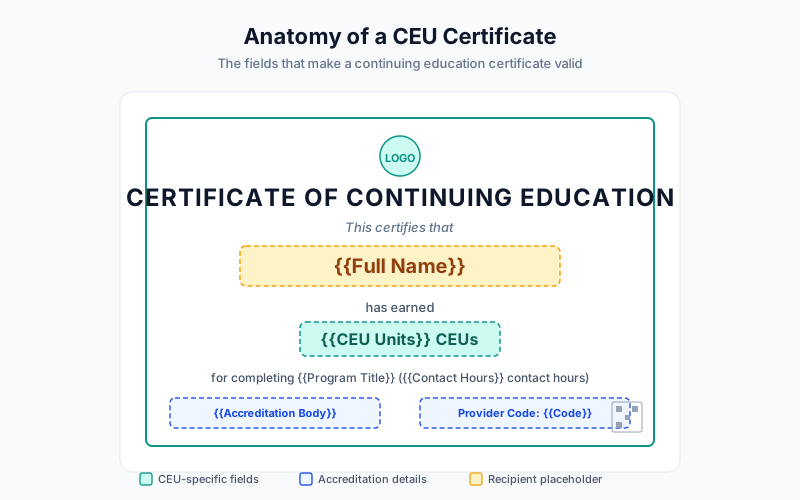
Here is a clean structure you can adapt. Each bracketed item is a placeholder that gets filled per recipient:
- Header: Certificate of Continuing Education
- Recipient line: This certifies that [Full Name]
- Credit line: has earned [CEU Units] CEUs ([Contact Hours] contact hours)
- Activity line: for completing [Program Title]
- Date line: on [Completion Date]
- Accreditation block: [Accreditation Body] - Provider Code: [Code]
- Signature block: [Authorized Signatory], [Title]
- Footer: Certificate ID [ID] with verification QR code
Keep the recipient name and the CEU value the two most prominent elements - those are what readers and reviewers look for first.
Sample CEU Certificate Wording
Standard CEU activity:
This certifies that [Full Name] has earned [X] CEUs ([Y] contact hours) upon successful completion of [Program Title], offered by [Organization Name] on [Date]. Accreditation: [Accreditation Body], Provider Code [Code].
Healthcare / licensing context:
[Full Name] has completed [Program Title] and earned [X] CEUs toward continuing education requirements. Delivered by [Organization Name], an approved provider of [Accreditation Body], on [Date]. Certificate ID: [ID].
Partial-unit short course:
This confirms that [Full Name] participated in [Program Title] ([Y] contact hours) and earned [0.X] CEU on [Date]. Issued by [Organization Name], Provider Code [Code].
Accreditation and Provider Codes
This is what separates a real CEU certificate from a generic completion certificate. To award official CEU credit, the activity usually must be delivered by an accredited provider - for example an IACET-accredited organization or a provider approved by the relevant licensing board.
Two things must appear on the certificate:
- The accreditation body that recognizes the credit
- The provider or approval code that ties your organization to that accreditation
If your program is not accredited, do not label the certificate as carrying CEUs. Issue a certificate of completion instead, which is honest and still valuable for records.
How CEUs Are Calculated
The standard formula is consistent:
- 10 contact hours = 1.0 CEU
- 5 hours = 0.5 CEU
- 20 hours = 2.0 CEUs
Contact hours count actual instruction time, not breaks or meals. Some accrediting bodies have specific rounding or minimum-duration rules, so always confirm with your accreditor before printing the number on a certificate.
Issuing CEU Certificates in Bulk
After a course or conference session, you often need to certify dozens or hundreds of professionals at once. Manual issuance is both slow and risky when accreditation details must be exact. The reliable workflow:
- Export your completion list with name, email, CEUs, contact hours, and date
- Add the accreditation body and provider code as columns
- Save the file as a spreadsheet (Excel or CSV)
- Upload it to SendCertificates with your CEU template
- Each professional receives a personalized, QR-verifiable CEU certificate by email
Because every field - including the CEU value and provider code - fills automatically from your data, you avoid the transcription errors that get certificates rejected. For the general completion-certificate version of this process, see our training completion certificate guide.
Getting Started
A CEU certificate has to be precise: the right units, the right accreditation details, and a way to verify it. Get the template right once and issuing them becomes routine.
SendCertificates lets you build a CEU template with all the required fields, then auto-fill and email personalized, verifiable certificates to an entire cohort from a single spreadsheet - with 50 free credits to start.
Related Guides
Tags