The best certificate of completion wording is one clear sentence: "This certifies that [Name] has successfully completed [Course Title] on [Date]." Add the issuer's name and a signature and you have a valid certificate. Everything else is optional polish.
Below you will find the structure of that sentence, copy-paste samples for common situations, and the mistakes that make certificate of completion text look careless.
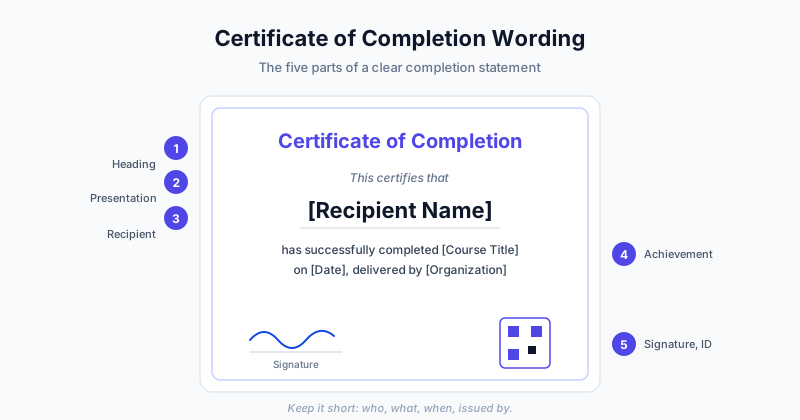
The Structure of Certificate of Completion Wording
Almost every good certificate follows the same five-part pattern:
- Heading - "Certificate of Completion"
- Presentation line - "This certifies that" or "Awarded to"
- Recipient - the learner's full name
- Achievement line - what they completed, with the title and optional hours
- Closing details - date, issuer, signature, and optionally an ID
Because the pattern is fixed, the only real decision is the tone and how much detail to add. If you want the wider checklist of fields, see our certificate of completion guide.
Certificate of Completion Wording by Context
Replace the bracketed parts with your own details.
Course
This certifies that [Name] has successfully completed the course [Course Title] ([X] hours), delivered by [Organization], on [Date].
Training Program
[Organization] hereby certifies that [Name] has completed the [Training Title] training program on [Date], having met all attendance and assessment requirements.
Workshop
Awarded to [Name] for completing the [Workshop Title] workshop held on [Date]. Thank you for your participation and hard work.
Online Course
This is to certify that [Name] has completed all modules of [Course Title], an online course offered by [Organization], on [Date].
Compliance or Safety Training
This certifies that [Name] has completed [Compliance Topic] training as required, on [Date]. This certificate is valid until [Expiry Date].
Kids and Young Learners
Congratulations to [Name]! You completed [Program Title] and did a wonderful job. Keep learning and keep shining.
For more training-specific language, our training completion certificate guide goes deeper.
Formal vs Warm Wording
Tone should follow purpose.
| Situation | Tone | Example opening |
|---|---|---|
| Compliance, accredited, professional | Formal | "This certifies that..." |
| Corporate training | Neutral | "Awarded to..." |
| Community classes, workshops | Warm | "Congratulations to..." |
| Children's programs | Friendly | "Well done, [Name]!" |
A formal certificate may be shown to an employer or regulator, so it should read like a record. A warm one is meant to be kept and celebrated. Do not mix them: a playful line on a compliance certificate undermines it.
Adding Optional Detail Without Cluttering the Certificate
Once the core sentence is in place, you can add a second, smaller line. Choose only what the reader will genuinely use:
- Hours or duration: "a 12-hour course" helps with CPD and employer records.
- Skills covered: "covering budgeting, forecasting and reporting" tells a reader what the learner can now do.
- Result: "with a score of 85 percent" only if you actually assessed and want to show it.
- Validity: "valid until [Date]" for safety or compliance training that expires.
- Certificate ID: a short code in small print, so the certificate can be looked up later.
A good test is to read the certificate aloud. If it takes more than about ten seconds, cut something. The main statement should carry the meaning, and the details should sit quietly underneath it.
Useful Phrases to Reuse
If you want a different verb or opening, these all work:
- "has successfully completed"
- "has fulfilled all requirements for"
- "has satisfactorily completed"
- "is hereby recognized for completing"
- "has demonstrated the knowledge required in"
- "in recognition of completing"
Pick one and use it consistently across all your certificates. For more variations, browse certificate wording examples, and for recognition language see certificate of appreciation wording.
What to Avoid in Certificate Verbiage
- Overclaiming. Do not write "certified" or "qualified" if the course only confirms attendance and completion.
- Vague titles. "Training" tells nobody anything. Name the course.
- Missing dates. An undated certificate is hard to trust.
- Typos in the name. This is the single most embarrassing error.
- Too much text. If it needs a paragraph, the wording is doing too much.
- Flowery language. Plain words read as more professional.
If you are unsure whether to say "completion" or "attendance", read certificate of attendance vs completion so the wording matches what the learner actually did.
Filling the Wording Automatically
Good wording is only useful if it is accurate for every person. Write the sentence once with placeholders for name, course, date and hours, then pull those values from a spreadsheet. That way the template stays identical and only the personal details change, which removes copy and paste mistakes. Our guide to generating certificates from a CSV shows the setup, and the broader walkthrough is in how to create certificates for a course.
Getting Started
Pick the sample above that fits your situation, adjust the tone, and put it in a template. SendCertificates lets you design or choose a template, upload a spreadsheet of recipients, and fill name, course and date fields automatically before emailing certificates in bulk, with QR code verification and delivery tracking. You can sign up free and start with 50 free credits.
Related Guides
Tags