"Certificate of attendance" and "certificate of completion" sound interchangeable, but they make very different claims about a participant. This guide explains the real difference, when to use each, what to write on them, and how to issue both correctly.
The Core Difference in One Sentence
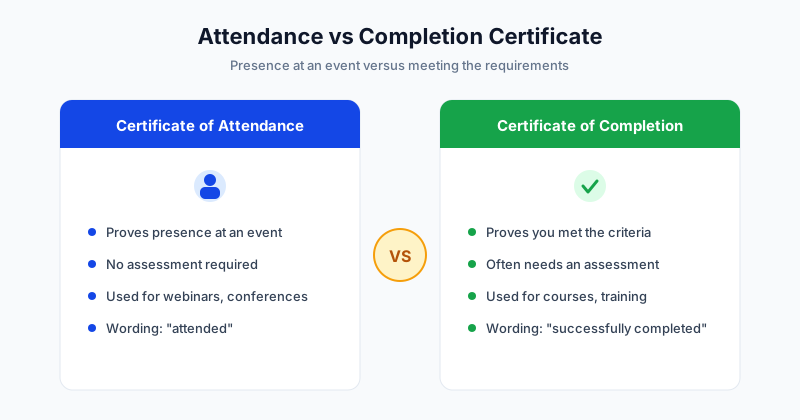
A certificate of attendance proves a person was present. A certificate of completion proves a person finished and met the requirements. Presence versus accomplishment is the whole distinction, and getting it right protects your program's credibility.
When you hand someone a completion certificate, you are vouching that they met a standard. When you hand them an attendance certificate, you are only confirming they showed up. Confusing the two either overstates what a participant did or undersells real achievement.
What a Certificate of Attendance Means
A certificate of attendance documents that someone took part in an event, session, conference, webinar, or workshop. It does not assess whether they learned anything, passed a test, or met any criteria. Its job is to record presence.
Typical uses include:
- Conferences and seminars
- Webinars and live online sessions
- Workshops where there is no graded outcome
- Continuing education events where hours of attendance are tracked
Attendance certificates are common in professional settings where people need to log hours, such as continuing education credits. The certificate becomes a record of time spent, not skill gained.
What a Certificate of Completion Means
A certificate of completion is a stronger statement. It confirms that the recipient finished an entire program and satisfied its requirements. Those requirements might include attending every module, submitting assignments, or passing a final assessment.
Typical uses include:
- Online courses with defined learning outcomes
- Training programs with assessments
- Multi-session bootcamps and certification tracks
- Onboarding or compliance programs that must be fully completed
Because a completion certificate implies a standard was met, it carries more weight with employers and institutions. It is the difference between "I attended a Python workshop" and "I completed a Python course and passed the final project."
Side-by-Side Comparison
| Factor | Certificate of Attendance | Certificate of Completion |
|---|---|---|
| What it proves | Presence at an event or session | Finishing a program and meeting criteria |
| Implies a standard met? | No | Yes |
| Common for | Conferences, webinars, workshops | Courses, training programs, bootcamps |
| Assessment involved? | Usually none | Often, such as a test or project |
| Weight with employers | Supporting evidence | Stronger, closer to a qualification |
| Typical wording | "attended" or "was present at" | "successfully completed" |
When to Use Each
Choosing the right certificate comes down to what actually happened and what you are willing to vouch for.
Use a certificate of attendance when:
- The event had no graded outcome or assessment.
- You only need to confirm participation or log hours.
- Everyone who showed up should receive the same recognition.
Use a certificate of completion when:
- Participants had to meet defined requirements.
- There was an assessment, project, or minimum standard.
- You want the credential to signal genuine accomplishment.
Many programs do both. Give an attendance certificate to everyone who joins a multi-day training, then award a completion certificate only to those who finish all modules and pass the final assessment. This rewards effort fairly while keeping the completion certificate meaningful.
What to Write on Each Certificate
Wording is where the difference becomes concrete. The verbs matter.
Certificate of attendance wording:
- "This certifies that [Name] attended [Event] on [Date]."
- "[Name] was present at [Session], a [X]-hour program held on [Date]."
Certificate of completion wording:
- "This certifies that [Name] has successfully completed [Program]."
- "[Name] completed all requirements of [Course] on [Date]."
In both cases, include the recipient's full name, the program or event title, the date, the duration where relevant, the issuing organization, and a verification link or QR code. For accuracy, never use "successfully completed" on an attendance certificate, because it implies a standard that attendance alone does not prove.
Common Mistakes to Avoid
The most frequent error is wording mismatch. Issuers sometimes reuse a single template for every event and forget to change the verb, so attendees receive certificates that claim they "successfully completed" a program they only watched. This quietly inflates credentials and can damage trust if a verifier digs into what actually happened.
A few other pitfalls are worth avoiding:
- Mixing the lists: Sending completion certificates to everyone who registered, including no-shows, defeats the purpose. Keep attendance and completion lists separate and accurate.
- Skipping verification: A certificate with no QR code or verification link is easy to fake and harder for an employer to trust, regardless of which type it is.
- Vague descriptions: "Attended a workshop" tells a reader very little. Name the specific event, topic, and duration so the certificate carries real meaning.
- Wrong audience expectations: Do not market an attendance certificate as a qualification. Be clear with participants about what their certificate proves so no one is surprised later.
Getting these details right is what keeps both certificate types credible over time.
How to Issue Both Correctly at Scale
Once you run events and programs regularly, issuing these certificates by hand becomes a bottleneck. The practical solution is to template each type once and generate them in bulk.
A clean workflow looks like this:
- Build one attendance template and one completion template.
- Keep two lists: everyone who attended, and everyone who completed.
- Upload each list to generate personalized certificates automatically.
- Email them with verification links, and track delivery.
With SendCertificates, you can manage both certificate types from a single account, personalize every certificate from a spreadsheet, and add QR verification so recipients can prove authenticity. That keeps the distinction between attendance and completion intact even when you are sending hundreds at once.
Get Started
Whether you are running a one-day conference or a multi-week training program, issuing the right certificate protects your credibility and gives participants exactly the recognition they earned. SendCertificates lets you create attendance and completion certificates, personalize them in bulk, and send them with built-in verification and delivery tracking. New accounts get 50 free credits, so you can issue your first batch of either type at no cost and see the full workflow before you scale.
Related Guides
Tags