An attendance certificate is a short document that confirms a named person was present at an event, session or training, and states when and for how long. To write one, include the attendee's name, the event title, the date, the hours attended and an authorised signature. Below are six copy-paste samples (conference, seminar, workshop, CPD training, webinar and school), a checklist of required fields, and guidance on wording hours, choosing a signatory and sending certificates in bulk.
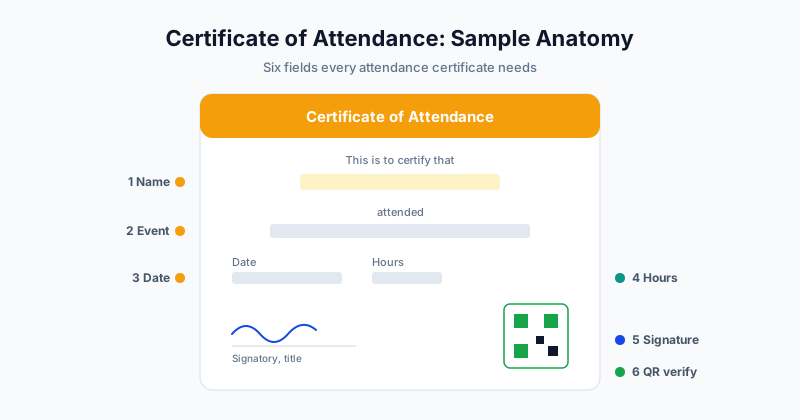
Required Fields Checklist
Every attendance certificate, whatever the event, needs these:
- Attendee's full name, spelled as the person registered
- Event or programme title
- Date or date range (and venue, or "online")
- Hours attended, if the certificate will be used for CPD or credit
- Organiser name and logo
- Authorised signature with printed name and title
- Date of issue
- Certificate ID or QR code so the certificate can be verified
Optional but helpful: a one-line description of the event, a CPD or accreditation line, and a unique link for verification. For more on what makes a document count as proof, see our guide to proof of attendance.
6 Copy-Paste Attendance Certificate Samples
Replace the bracketed text for each attendee.
1. Certificate of attendance for a conference
This is to certify that [Full Name] attended [Conference Name], held at [Venue, City] from [Start Date] to [End Date], organised by [Organisation Name].
If you need a fuller version for delegates, add the sessions or tracks attended. This is the most searched format, usually phrased as "certificate of attendance conference".
2. Seminar attendance certificate
This certificate is awarded to [Full Name] in recognition of attending the seminar "[Seminar Title]" on [Date], hosted by [Organisation Name].
Seminars are short, so the date and title are enough. See our seminar certificate guide for layout ideas.
3. Workshop attendance certificate
This is to certify that [Full Name] attended the [Workshop Title] workshop on [Date], comprising [X] hours of hands-on sessions, conducted by [Facilitator Name] at [Organisation Name].
Mention hours when the workshop is practical. The workshop certificates page has ready template layouts.
4. Training certificate with hours and CPD
This certifies that [Full Name] attended [Training Title] delivered by [Organisation Name] on [Date], totalling [X] contact hours. This attendance may be recorded as [X] CPD hours where applicable.
Only include a CPD or credit line if your programme is actually recognised for it. If it is accredited, check the format in our CEU certificate templates guide.
5. Online webinar attendance certificate
This is to certify that [Full Name] attended the live webinar "[Webinar Title]" on [Date], hosted online by [Organisation Name], for a duration of [X] minutes.
Online sessions often need a minimum attendance rule. Our webinar certificates guide explains how to issue them from attendance data.
6. School attendance certificate
This is to certify that [Student Name], a student of Class [X], attended [Programme or Term] at [School Name] from [Start Date] to [End Date], with an attendance of [Y]%.
Include a percentage only if you have the real figure. For other education formats, see our school certificate guide.
How to Word Hours
Hours are where most attendance certificates go wrong. Keep it simple:
- Say "attended [X] hours" or "[X] contact hours" for training and CPD.
- Use "for a duration of [X] minutes" for short online sessions.
- For multi-day events, state the total hours and the date range, not each day.
- Do not round up. If someone left early, either issue a certificate for the hours they actually attended or do not issue one.
Who Should Sign
The signatory should be someone who can vouch that the person attended. Good choices are the event organiser, course director, programme head or principal of the host institution. Print their name and title under the signature, because an unnamed signature carries little weight. If you issue many certificates, use a digital signature image on the template so every certificate looks consistent.
Attendance vs Completion
An attendance certificate shows presence. A completion certificate shows that the person finished and often met a requirement such as passing an assessment. Do not mix them: using "completed" wording on an attendance-only document can mislead whoever reads it. Our guide on certificate of attendance vs completion sets out when to use each.
Sending Attendance Certificates in Bulk
If your event has more than a handful of attendees, typing each certificate is slow and creates spelling errors. A reliable workflow:
- Export your attendee list with name, email and any hours or session columns
- Save it as a CSV or Excel spreadsheet
- Design one template with placeholders for name, event, date and hours
- Upload the spreadsheet and map the columns to the template fields
- Send every certificate by email, with a QR code for verification
For the full process, read our certificate of attendance guide, and for event-specific advice see the event certificate guide.
Getting Started
A good attendance certificate is short, accurate and easy to verify. Use one of the samples above, check it against the fields list, and send it promptly while the event is fresh. SendCertificates lets you build a template, upload your attendee spreadsheet, and email personalised, QR-verifiable certificates in bulk, with 50 free credits to start. You can create an account here.
Related Guides
Tags