A certificate of recognition acknowledges what someone achieved, a certificate of appreciation thanks them for what they gave, a certificate of participation confirms they took part, and a certificate of attendance confirms they were there. The four sound alike, but each sends a different message to the person receiving it. Choosing the wrong one can make a thank-you feel like a participation trophy, or a real achievement feel like a formality.
This guide compares all four side by side, shows when to use each one, and gives sample wording you can adapt.
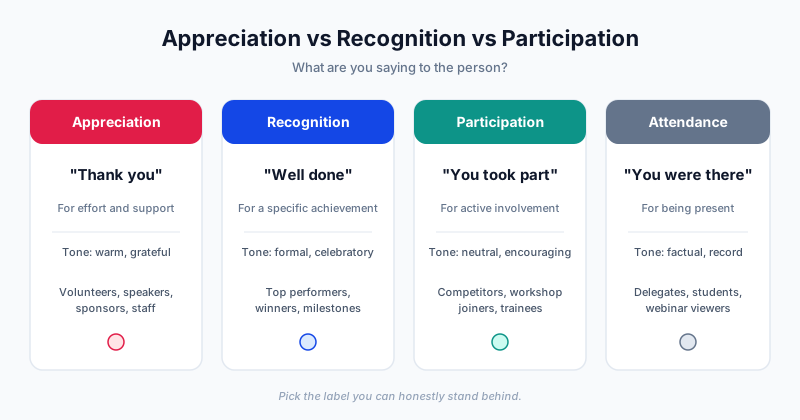
The Quick Answer
Ask one question: what are you saying to this person?
- "Thank you for your help" is appreciation.
- "Well done on what you achieved" is recognition.
- "You took part" is participation.
- "You were present" is attendance.
Comparison Table
| Appreciation | Recognition | Participation | Attendance | |
|---|---|---|---|---|
| Purpose | Thank someone for effort or support | Acknowledge a specific achievement or quality | Confirm active involvement | Confirm presence at an event or session |
| Tone | Warm, grateful | Formal, celebratory | Neutral, encouraging | Factual, record-based |
| Who gets it | Volunteers, speakers, sponsors, staff, mentors | Top performers, winners, high contributors | Competitors, workshop joiners, trainees | Delegates, students, webinar viewers |
| When to issue | After a contribution or at the end of a project | After a result, milestone or evaluation | After the activity ends | After the session or event |
| Does it prove a skill? | No | Not formally, but names the achievement | No | No |
| Sample wording | "In sincere appreciation of your support" | "In recognition of outstanding performance" | "For active participation in" | "For attending" |
Certificate of Appreciation
A certificate of appreciation is a thank-you in formal form. It does not say the person was the best or passed any test. It says their time, effort or generosity mattered.
When to issue it
- Volunteers at the end of a drive or event
- Guest speakers, judges and trainers
- Sponsors and donors
- Employees after a major project or years of service
This certificate is presented to [Name] in sincere appreciation of your generous support and dedication to [Event or Organization].
For more detail, see our certificate of appreciation guide and the wording examples.
Certificate of Recognition
A certificate of recognition points to something specific the person did well. It carries more weight than a thank-you because it names an achievement, quality or result.
When to issue it
- Top performers or winners in a contest
- Outstanding contribution in a team or class
- Milestones, such as completing a difficult project
This certificate is awarded to [Name] in recognition of outstanding performance and commitment to excellence in [Area or Program].
If you have a clear criterion (a score, a result, a milestone), recognition is the honest label. Read the full certificate of recognition guide for formats and examples.
Certificate of Participation
A certificate of participation confirms the person took part in something active: a competition, workshop, training session or project. It is about involvement, not performance.
When to issue it
- Every competitor in a contest, including those who did not place
- Participants in a workshop, camp or hackathon
- Students who joined an activity
This certificate is presented to [Name] for active participation in [Event] held on [Date].
It is also worth separating participation from finishing a course. Our guide on participation vs completion certificates explains where the line sits.
Certificate of Attendance
A certificate of attendance is the most basic. It records that someone was present, usually with the date and sometimes the number of hours.
When to issue it
- Webinars, seminars and conferences
- Classes or training sessions where presence matters
- Events where proof of attendance may be requested later
This certifies that [Name] attended [Event] on [Date], totalling [X] hours.
Attendance vs Participation
These two are most often confused. A simple rule: attendance means present, participation means involved.
- Someone who sat through a webinar attended it.
- Someone who joined the group exercise, asked questions or competed took part in it.
If you cannot tell whether people engaged, use attendance. It is the safer and more accurate claim. For a deeper comparison, see certificate of attendance vs completion.
How to Choose
- Decide what you can honestly say. Do not call something recognition if there was no achievement to recognise.
- Match the tone to the audience. Volunteers and speakers want warmth, competitors want acknowledgement, delegates want a record.
- Check whether proof is needed later. If a certificate may be used for records, add dates, hours and a verification QR code.
- Keep the wording specific. Name the event, the date and the reason. Vague certificates feel generic.
Using Several Types at One Event
Most events use more than one. A two-day conference might issue:
- Attendance certificates to all delegates
- Participation certificates to workshop joiners
- Recognition certificates to winners of a competition
- Appreciation certificates to speakers and volunteers
With a spreadsheet of names and categories, you can generate each type in one go instead of making them by hand. Our event certificate guide shows how to organise this.
Getting Started
The right certificate is the one that says exactly what you mean. Once you know whether you are thanking, recognising, acknowledging participation or recording attendance, the design and wording follow easily.
SendCertificates lets you pick a template, upload a spreadsheet of recipients and email personalised certificates in bulk, with QR code verification and delivery tracking. You can start with 50 free credits.
Related Guides
Tags