If you only need one answer: an internship certificate (also called an internship completion certificate or certificate of internship) proves you finished a short training placement. An experience certificate proves you worked in a role for a stated period, and an offer or recommendation letter is supporting paperwork, not proof of completion. The three overlap, which is why students and HR teams often mix them up. This guide separates them, shows sample wording for each, and tells you which one to ask for.
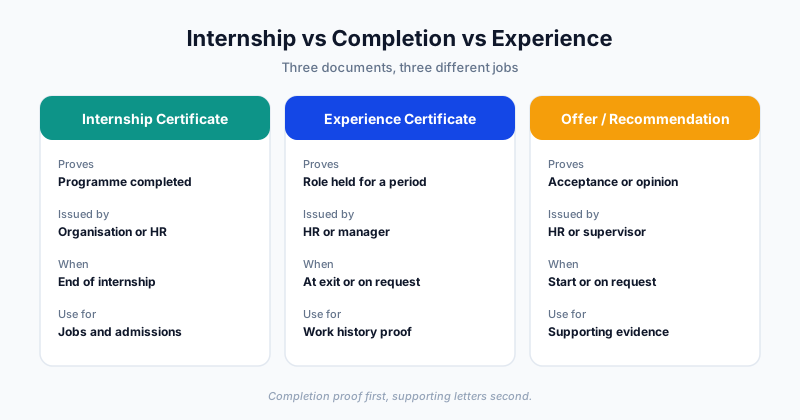
The Three Documents Explained
Internship certificate (internship completion certificate)
An internship certificate, sometimes searched as "certificate of internship", "certification of internship" or "certificate for internship", confirms that a person completed an internship programme. It names the intern, the organisation, the role or department, and the start and end dates. When it says "completion", it simply states that the full term was finished. For a full breakdown of fields and layout, see our internship certificate format guide.
Experience certificate
An experience certificate documents employment or sustained work in a role. It usually lists designation, tenure, key responsibilities and a line on conduct. Companies issue it when someone leaves, and some give it to long-term interns as well. Our experience certificate format guide covers the structure in detail.
Offer letter and recommendation letter
These are not certificates, but students often submit them alongside one. An offer letter shows you were accepted for the internship. It proves nothing about completion. A recommendation letter is a personal assessment from a supervisor about your skills and attitude. It supports an application but does not replace a completion document.
Side-by-Side Comparison
| Internship / completion certificate | Experience certificate | Offer or recommendation letter | |
|---|---|---|---|
| What it proves | You completed an internship programme | You worked in a role for a stated period | Acceptance (offer) or a supervisor's opinion (recommendation) |
| Who issues it | Organisation, HR, programme coordinator or training provider | HR or the reporting manager | HR (offer) or your supervisor (recommendation) |
| When it is issued | At the end of the internship | At exit, or on request after a longer engagement | At the start (offer) or on request near the end (recommendation) |
| Typical contents | Name, organisation, role, dates, brief work description, signatory | Name, designation, tenure, duties, conduct, signatory | Terms and start date (offer); skills, strengths and endorsement (recommendation) |
| Length | Short, one page | One page | One page |
| Best used for | Job applications, admissions, portfolios | Job applications that ask for work history | Supporting evidence |
Sample Wording for Each
Internship completion certificate
This is to certify that [Full Name] successfully completed an internship as [Role] in the [Department] at [Organisation Name] from [Start Date] to [End Date]. During this period, [he/she/they] worked on [brief description of work]. We wish [him/her/them] every success.
Experience certificate
This is to certify that [Full Name] worked with [Organisation Name] as [Designation] from [Start Date] to [End Date]. [His/Her/Their] responsibilities included [duties]. [His/Her/Their] conduct during this period was [satisfactory/good/excellent].
Recommendation letter (opening paragraph)
I am pleased to recommend [Full Name], who interned with our [Team] from [Start Date] to [End Date]. [He/She/They] consistently showed [two or three specific strengths], and I am confident [he/she/they] will contribute well to [job or programme].
Keep wording factual. A document with vague praise but no dates or role carries little weight.
Which One Do You Need?
For job applications
Employers look for proof of what you did and for how long. Submit your internship completion certificate if the placement was short, or an experience certificate if it was a longer engagement with defined responsibilities. Add a recommendation letter if the employer asks for references. See how to present these on a profile in our guide on adding a certificate to LinkedIn.
For higher studies and admissions
Admission panels usually want proof that you finished relevant practical work, so an internship completion certificate showing organisation, duration and field is the standard document. A recommendation letter from your internship supervisor often carries extra weight. An offer letter alone is not accepted as proof of completion.
Quick decision guide
- Finished a short internship: internship completion certificate
- Worked a long-term role with duties and an exit: experience certificate
- Applying where references matter: add a recommendation letter
- Only have an offer letter: ask for a completion certificate before you leave
For a student-side walkthrough, read our internship completion certificate guide for students.
What a Good Certificate Always Includes
Whichever document you receive, check it has:
- Your full name, spelled as on your ID
- Organisation name and, ideally, letterhead
- Role or department
- Exact start and end dates
- A short line about the work done
- Name, designation and signature of a real signatory
- A date of issue and, if possible, a certificate ID or verification link
If something is missing or wrong, request a correction while you are still in touch with the team.
For Organisations: Issue Them Properly
If you run an internship programme, handling certificates one by one in a document editor is slow and error-prone, especially across batches. The cleaner approach is to keep intern details in a spreadsheet, fill a single template with name, role, department and dates, and send every certificate by email. Adding a QR code lets a university or employer confirm that the certificate is genuine. Our internship completion certificates page shows how this works, and the bulk certificate guide covers sending in volume.
Getting Started
The right document depends on what you completed and who will read it. An internship completion certificate covers most student needs, while an experience certificate suits longer roles. SendCertificates lets you design an internship template, upload a spreadsheet of interns and email personalised, QR-verifiable certificates in one go, with 50 free credits to start. You can create an account here.
Related Guides
Tags