Digital badges have become a popular way to recognize skills and achievements online, but many people are unsure what they actually are or how they differ from a certificate. This guide explains what a digital badge is, the main types, what is inside one, and when to use them.
What Is a Digital Badge?
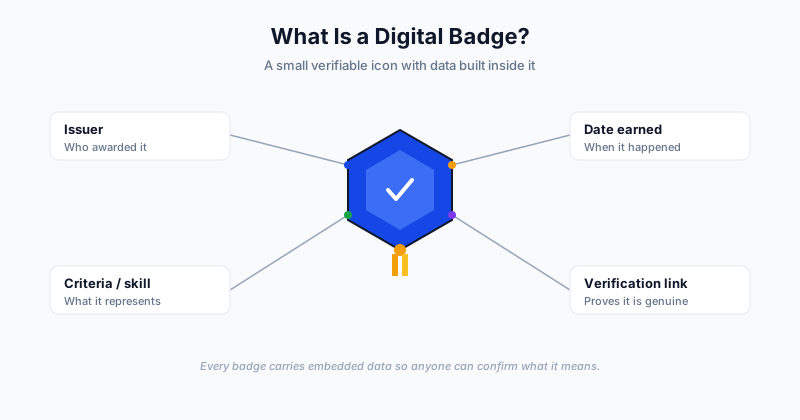
A digital badge is a small visual icon, often shaped like a shield, hexagon, or circle, that represents a specific achievement, skill, or credential. Unlike a plain graphic, a real digital badge carries embedded data: information about who earned it, who issued it, what it represents, and how to verify it.
That embedded data is what makes a badge more than decoration. When someone clicks or inspects a badge, they can confirm it is genuine and see exactly what the recipient did to earn it. This is the foundation of the Open Badges standard, a widely adopted framework that defines how badge data should be structured so badges work across different platforms.
In short, a badge is a compact, shareable, and verifiable signal of achievement, designed for the digital world where people showcase their skills on profiles and portfolios.
How a Digital Badge Differs From a Certificate
Badges and certificates are often mentioned together, and both are forms of digital credentials, but they serve different purposes. A certificate is a formal document, usually a PDF or web page, that proves a larger completion or achievement. A badge is a compact icon optimized for display and built around skill-level recognition.
| Factor | Digital Badge | Digital Certificate |
|---|---|---|
| Format | Small visual icon | Formal document or page |
| Best for | Skills, modules, milestones | Course or program completion |
| Display | LinkedIn, profiles, signatures | Applications, records, portfolios |
| Embedded data | Issuer, criteria, date, link | Recipient, achievement, verification |
| Granularity | Often one skill at a time | Often a whole program |
Neither is better in absolute terms. Many organizations issue both: a certificate as the primary credential and a badge for easy social sharing. For a deeper side-by-side comparison, see the related guide below.
What Is Inside a Digital Badge
The value of a badge lives in its metadata. A properly issued badge embeds four core pieces of information.
- Issuer: The organization or person that awarded the badge. This establishes credibility, because a badge is only as trustworthy as its issuer.
- Criteria or skill: What the badge represents and what the recipient had to do to earn it. This turns a vague icon into a meaningful claim.
- Date earned: When the achievement happened, which matters for time-sensitive skills and renewals.
- Verification link: A link or code that lets anyone confirm the badge is genuine and unaltered.
When all four are present, a badge becomes a self-contained credential. Anyone who sees it can understand what it means and prove that it is real, without contacting the issuer directly.
The Main Types of Digital Badges
Not all badges carry the same weight. They generally fall into a few categories, ordered roughly from least to most rigorous.
Participation Badges
These recognize that someone took part in an event, course, or community. They confirm involvement rather than mastery, similar to a certificate of attendance. They are useful for encouraging engagement and acknowledging presence.
Skill or Competency Badges
These represent a specific skill or competency the recipient has demonstrated, such as data analysis or public speaking. They are granular by design, often awarded at the module or task level, which makes them ideal for showing exactly what someone can do.
Achievement or Milestone Badges
These mark reaching a defined milestone, such as completing a streak, hitting a target, or finishing a stage of a longer journey. They are common in learning platforms and communities to motivate continued progress.
Certification or Micro-Credential Badges
These are the most rigorous. They recognize that the recipient completed a structured program and met defined standards, often including an assessment. A micro-credential badge functions as a compact, verifiable proof of a real qualification.
When to Use Digital Badges
Badges shine when recognition needs to be granular, visual, and easy to share. They are a strong choice when:
- You credential at the skill or module level rather than the whole-program level.
- Your audience lives on LinkedIn and online profiles where icons stand out.
- You want to motivate progress with milestone or streak recognition.
- You want recognition that travels and verifies across platforms.
Badges are less ideal when you need a formal, document-style credential that an employer or institution expects to see in full. In those cases a certificate is the better primary format, with a badge as an optional companion for sharing.
Where Digital Badges Are Displayed
A badge is only valuable if people see it. Common display destinations include:
- LinkedIn profiles, in the certifications or licenses section
- Email signatures, linking back to verification
- Personal websites and digital portfolios
- Online learning profiles and community pages
Because each badge links back to its verification data, every place it appears doubles as proof. That portability is exactly why badges have become a default way to show skills online.
Badges and Certificates Together
For many organizations the smartest approach is not choosing one format but combining them. Issue a formal, verifiable certificate as the official record, and pair it with a badge for social visibility. SendCertificates specializes in formal, QR-verified digital certificates issued at scale, which gives recipients the credible primary credential that a badge can then point back to.
Get Started
If you are recognizing achievement in a course, training program, or community, start with a credential people can trust and verify. SendCertificates lets you design once, personalize from a spreadsheet, and send verifiable certificates in bulk with QR verification and delivery tracking. New accounts include 50 free credits, so you can issue your first batch at no cost and see how verifiable credentialing works before you scale.
Related Guides
Tags